China is very strict on censoring the internet with the use of firewalls. Although in the past, Chinese officials have not interrupted Gmail and other foreign email services. However recently, Chinese official’s internet censorship has grown even tighter with more firewalls. The Chinese government does all of this in an attempt to curb any civil unrest at home. Officials have even targeted Google’s e-mail service, Gmail. China claims that problems accessing Gmail is because of Google. Google has stated that there is nothing wrong with Gmail but that China is censoring and tampering with Gmail. Even private VPN’s used for private access to blocked websites, some for corporate use, have been disrupted by Chinese government interference.
-Nate Jones
Mongolia is on the verge of opening a new national stock exchange. Mongolia’s economy, while small at around $6 billion, will be the world’s fastest growing over the next five years, increasing to $23 billion by 2013. The London Stock Exchange is the front-runner among four contenders to run the new Ulan Bator exchange, so Mongolia will not have to start from scratch. Mongolia stands to benefit from the convergence of three booms: in China, in commodities and in emerging markets.
Jonathan
The article “Chinese Rush to Buy Soap Ahead of Price Increases” explains the increased inflation that is affecting China and especially affecting consumers who are forced to pay for rising commodity costs. Soap and detergent prices, alone, are expected to increase 5 to 15% over the next few weeks. One of the biggest problems facing the Chinese workforce is that wages and paychecks are not keeping up with increasing prices. The consumer-price index rose 4.9% in February when compared to February 2010. It is interesting learning about Chinese inflation because it helps give better insight into China’s problems and attitudes as a country.
Korea Herald: http://www.koreaherald.com/national/Detail.jsp?newsMLId=20110321000783
While we won't be visiting North Korea on our study abroad, technically we will when we visit the Demilitarized Zone (DMZ), the 38th parallel that separates the peninsula in half and serves as a buffer zone.
Just last week, North Korea raised tensions in the area again when it accused American troops of trespassing into the DMZ (one headline even read "N.Korea accuses US troops of 'partying' inside DMZ"). The North claims that U.S. troops made 50 trespasses in March, including an incident where a group of soldiers allegedly came within 20 meters of the DMZ and threw bottles of alcohol at North Korean troops.
North Korea's Central News Agency promised "human damage" in retaliation if the trespassing continues.
While the financial implications of the U.S. having troops in Korea is clear (it's been more than 50 years since the war and taxpayers are still fronting 28,500 U.S. troops to keep the region stabilized), I can't really tell how this news has or would affect business on the peninsula. I tried making a really unscientific look at the KOPSI Composite Index (a Korean index) to see if the market went down around March 20, but really couldn't see if military provocations really impact the market there. --Phil Volmar
Japan has suffered so much devastation in the past month that it’s hard to say that there’s a lot of rough road yet for the country; unfortunately, this is indeed the case. As the aftershocks and continual radiation scares threaten the country, Japan must also have its rebuilding to look forward, or not-forward, to in future years. According to the World Bank, Japan’s reconstruction may take up to 5 years. Damages between $123 billion and $235 billion have been cited by World Bank, with the Japanese government allocating $12 billion of the current budget to the reconstruction, and much more in the later budgets. As a result of these numbers, the government is putting a tighter monetary policy on spending.
-Rich
The Hong Kong stock exchange was the world’s richest IPO market, with $445 billion raised in 2010. Hong Kong has been the site for many Chinese and Asian companies to go public and trade, but still has some regulatory concerns. The Securities and Futures Commission recently came out and said that 17 IPO sponsors have been negligent in bringing companies into the public market. These sponsors have not performed quality due diligence required. There have recently been several scandals involving fraud in Chinese companies as well.
Bradley E. McMullin

cnet News: http://news.cnet.com/8301-13578_3-20048759-38.html
Most people know that in 2009, the People's Republic of China started blocking all Google searches in mainland China. Now, to add to Google's frustration, the government may start interfering with Google Maps.
China's State Bureau of Surveying and Mapping recently said that it hasn't received an application from the search giant to renew its license for online mapping services. Bloomberg reported that Google has stated in response, "We are examining the regulations to understand their impact on our maps products in China."
The potential blow to yet another of Google's online services is part of China's strategy to "crack down on 'illegal' online mapping services in light of their ability to reveal 'sensitive and confidential information.'"
This article is a follow up to one that I had done a few weeks ago about the strength of the yen to the USD. The Yen continues to fall and has now hit an all time low. Analysts speculate that this could be because of short-term buyers who expect the yen to go into high demand after the natural disasters. This also has effect of trade and direct exports. It is expected still that the Finance Ministry will have to intervene to weaken the yen to a reasonable trading point.
By HYUNG-JIN KIM
March 30, 2011
Associated Press
For decades Japan and South Korea have disputed over which country controls some islets that are located between them. The islets are basically controlled by South Korea but claimed be Japan. These islets are valuable to either country because they have rich fishing areas around them and also lie near deposits of methane hydrate, which can be used to produce natural gas. Recently, ties have been strong between the two governments and South Korea has put together a lot of aid to help with the earthquake recovery. Japan recently approved a history textbook that indicates the islets are theirs, this has stirred up the controversy and brought a sour taste South Koreans who have been helping in the relief efforts for Japan.
Sam Gardner
This article focuses on South Korea and its central banking system. The board of the bank is composed of 7 people, but there has been a vacancy for almost a year now that has the government worried. With inflation an ever-looming problem and the need to grow as an economy the Koreans are worried that a deadlock might occur on some decisions that would halt their progress. While they have been able to function with the help of the Governor lately, he holds no voting power and the risk of a deadlock still exist with the board consisting of an even number of voters. What has them really peeved is the lack of importance the government has placed on the board.
-Steen
Last year, November 2010, there was a G20 summit in Seoul, Korea. Korea was the first G20 nation among Asia that hosted the annual summit. This year, it seems like China is hosting a G20 event in Nanjing. However, according to this article, one of the most controversial topics, Chinese currency, will not be on the agenda. It says, China has long been under pressure to allow its currency to strengthen, with many key trading partners claiming it is undervalued, giving the country an unfair advantage in international trade. I thought it was very interesting to see the actual event that is tied into our discussion last week.
Beginning of the semester, I remember talking about restricted usage of the internet in China, such as blockade of Facebook, censorship of the phone call, and so on. Here is another article of conflict between Chinese government and Google. According to this article, China's State Bureau of Surveying and Mapping confirmed that it has not received an application from Google for a license for Google Maps service. Google’s response was, "We are examining the regulations to understand their impact on our maps products in China." In fact, China has given licenses to 105 Web sites that provide online mapping in the country, including Baidu, Sina, Nokia, and China Mobile. Google had various conflicts between Chinese government with censorship issues beginning of their entering to Chinese market. I believe that as China’s market and economy grows, the government will slowly lose their power to control everything including people’s right to know.
Minji Choi
NYU is going to open a new campus in Shanghai, China. They have already opened smaller campuses in other countries, but they are really excited to have a campus in the world’s second largest economy. Because so many people want to come to the United States for college, these campuses scattered across the world will allow students to get a degree with the same caliber in their own country. It will also give Americans the chance to study abroad with more ease. If someone is interested in studying about Chinese culture, then going to the Shanghai NYU campus would be a great place for them.
For those who are worried about the radiation, here is a link that you can check the radiation among Japan and Korea.
| 157.5nSv/h (=126nGy/h) 0.0037mSv/d 1.37mSv/y |
This article talked about the struggles in Mongolia with inflation and some of the techniques to stop the threat. The central bank’s focus is to keep confidence in the togrog, the currency in Mongolia. A key to this is sustaining their copper and coal mining. The mines secure a foundation for the togrog and supply many of the jobs for Mongolians. Despite efforts inflation is estimated around 200%. This interested me because I lived in the home of the Mongolian Mission President on my mission. I grew a love and curiosity for the place.
Matt Smith
Many areas in Japan are suffering from rolling blackouts due to the decreased supply of power in the country. As nuclear reactors and other power companies have been forced to shut down and repair their facilities after the devastating earthquake and tsunami, it has been estimated that nearly 11 percent of power produced by Japanese companies is currently out of service, taking a toll on residents and business owners. A positive side to the disaster may be that the already lean and efficient Japanese factories which are now being forced to operate at reduced levels may find yet even greater solutions or innovations that allow them to operate at these decreased levels and cutting costs in the future. Although Japanese officials and engineers are working around the clock to get power back to their country, they still predict rolling blackouts throughout the summer. The solution to the power crisis is complicated because of poor relations between northern and southern Japan. Southerns had a spat with the northerners many years ago and now operates their power system on a different frequency making it impractical to send surplus power from their system to the north. I like this article because it talks about a side effects to the disaster that I had never considered and is an example of how a trial, even as big as a tsunami, in the end can help society improve. If the South found a way to work out their differences with the north, or the Japanese factories learned how to operate even more efficiently, these could be positive outcomes only come about because of a disaster.
-Nick
The Japanese and the countries supported by them knew this was coming. From the Japanese earthquake they have had to shut down lots of automakers, including General Motors, Ford, Toyota and Honda. About 13 percent of worldwide auto output has been lost due to parts shortages and IHS Automotive estimated it might cut back 30 percent within six weeks. “In about two weeks, we'll start seeing empty ships or no ships arriving in a number of ports,” he said. Sean McAlinden “Remember, there are 30 000 components in a car. We could see the effect on practically every production line in North America and most of Europe because of this supply interruption, this black swan for the global auto industry in Japan.”
“Don’t worry, be happy”
The Economist
March 30, 2011
During the recent National People’s Congress, Chinese officials declared that one of their priorities over the next few years would be to create a “happy China.” The growth of a happy people is more important than the growth of China’s GDP according to one official. Smaller provinces and cities such as Beijing and Guangdong have already established creating happier people as one of their priorities. It is still unclear what benchmarks will be used to measure happiness but some critics are worried this goal will be much like China’s previous goal of “political reform”—a goal that was made but never followed up on until the Party declares that the goal was achieved. To me, this is an interesting indicator of the future of China. I believe we will begin to see much more involvement on the part of civilians in the next few years in China.
--Jared Colton
After trying to maintain its GDP for the last 8 years, Kore has hit for GDP growth by quarter. The country grew 6.2% during 2010. THe Bank of Korea released a statement telling how the economy succeeded last year saying that there was a "sharp upturn in facilities investment, expanded exports and a pickup in growht in private consumption." Now the governement is taking precautionary steps to hold back inflation fears that arise with growth.
Japanese companies have been unable to produce specific parts needed for mainenance in cars delivered to the United States. Toyota in particluar has closed some of its plants forat least 30 days. While there are some supplies to last, some dealers fear that they will not have the necessary parts to do the expected mainenance work in the shrot term for their customers. THis may continue to grow into a bigger problem because companies such as TOyota or Nissan have a wide array of 500 specific parts used for separate cars. Hopefully these Japanese can figure out how to keep up wiht U.S. demand for their products and services.
My first article titled, “Dream Deferred,” discusses the change of a popular Chinese car company known as the BYD (Build Your Dreams) from an optimistic company to one that is currently struggling. Whereas two years ago the company was booming with success, stock investors and potential, now, to the shock of many, its sales are declining. Last year it fell short of selling 700,000-800,000 cars than what it expected. The reason they attribute for this lack of success is the change of features in cars and buyer’s receptiveness to these changes. “Chinese buyers are proving to be more loyal to features than brands. When something nicer comes along, they buy it.”-Mr. Laprise of CLSA. I thought this was significant because it shows the power purchasers have over the market. Companies can be as optimistic as they want about whether or not their product will sell, but that doesn’t change the demands, desires, and trends of buyers; who ultimately determine the success of a product. This article reveals the ultimate key to success in business is creating a product your buyers can’t live without.
On April 2, 2011, South Korea’s foreign minister will visit Ethiopia and Congo in Africa. The purpose of this visit is to discuss business possibilities. After, observing actions taken by China to tap into natural resources located in Africa, Korea is exploring its own possibilities. I find this interesting because this action has both economic and political implications. China’s involvement in Africa has received much criticism by the West. While this may be a great economic move for South Korea, the country stills needs to be careful not harm political ties with western nations.
-Steven Hall
Week #4 Articles
This article is from the Wall Street Journal website and is entitled Turn to Korean Suppliers Could Hit Japanese Exporters Long-Term. I liked this article because it showed how the earthquake effected other countries’ economies. Because Japan is currently unable to produce many of its products for export, product seekers have turned to Korea for help. Because of this flux in trade it is predicted that the South Korean economy will “grow 0.05 to 0.25 percentage points this year.” I just though it was crazy that a country could have that much growth in their economy from one natural disaster that didn’t effect it. I think this article helps to demonstrate the idea of a global economy.
http://online.wsj.com/article/SB10001424052748704517404576221932309100672.html
-Dustin Parkinson
A famous Chinese Democracy activist named Liu Xianbin was sentenced on March 25 to a pretty heavy penalty of 10 years. The conviction was mostly based on Liu’s overseas articles that support for democracy and human rights. Dozens of lawyers and writers who advocate for the same things have also been convicted. Some have “disappeared” mysteriously. This act by the Chinese Government shows its growing intolerance towards human rights and it runs counter to what China’s leadership’s statement of recognizing the need to reform. Communism and Reforms…I don’t think they are on the same page.
My Nguyen
Week 4 Post
With more than 25,000 people dead or missing, Japan also has to suffer from the total cause of damage by the tsunami, estimating around 25 trillion yen or $309 billions. The fact that several countries, including China, the United States, etc. have banned some Japanese produce imports because of concerns about radiation has made the situation even worse. International companies have also moved their people out of Tokyo. Meetings, events have been cancelled. Tourists are not likely to come to Japan anymore. This is such a hard time for Japan but its people are strong and believe that “the sun will rise again.”
My Nguyen
Week 4 Post
China has redefined their 5-year plan to now say that their GDP will grow 7 percent as compared to the earlier stated 7.5 percent over the next 5 years. A big factor in this change is previously the country has increased its exports and now controls around 9 percent of the global export, however, to continue at its current growth rate would mean that by 2020 they would control 25% of the worlds exports which is impossible. The government in recent years has also seen more increase than was expected, but they feel that those expectations and reality will begin to align themselves.
http://www.businessweek.com/globalbiz/content/mar2011/gb20110317_990327.htm
The World Bank’s inaugural “Conference on East Asian Development” started with a minute’s silence in memory of Japan’s dead from the earthquake and tsunami of March 11th. During the conference, Japan’s deputy vice-minister of finance for international affairs, Naoko Ishii, waved a copy of a recent The Economist and exclaiming “We are not falling out, we are not melting down”. This was her way of reassuring everyone that Japan was not about to “turn inwards”, but was intent on carrying on its regional and international responsibilities. She was also stating that western newspapers exaggerating the ill effects of the crisis on Japan. She assured western newspapers are “alarmist” and overly negative and that Japan would rebuild itself quickly.
The World Bank’s first assessment of the damage is that real GDP growth will slow, but this slowdown will only be temporary and that growth will resume mid-201. At this time, reconstruction will go under way, and the impact on other Asian economies will most likely be limited. This is believable since in 1995, after the Kobe earthquake hit, trade slowed only temporarily, Japanese imports recovered within a year and exports returned back to 85% of pre-quake levels.
South Korea was the first member of the Organization for Economic Cooperation and Development to emerge from global recession. The Asian crisis that crippled the country's economy in 1998 gave South Korea experience in recovering from economic crisis. South Korea plans on using the gap created by the slow recovery of the US and other countries to their advantage, to become a“respected global soft power with the clout to mediate between rich and poor nations on global issues such as climate change and financial regulation.” South Korea’s government and economic system are models for other Asian countries, because their economic and political growth and an increasingly well-established multiparty democracy that respects free speech and election results.
Jonathan
http://english.hani.co.kr/arti/english_edition/e_northkorea/469470.html
The Hankyoreh Korean newspaper reported today that census data reveals that the Communist north is experiencing a famine, decreasing economic participation, and living fewer years.
The statistics were released yesterday. Among other findings from the analysis are that North Korean men live more than 10 years shorter than their South Korean counterparts, even though the fertility rate is higher in the North: 2.0 compared to 1.2. Additionally, the isolationist country is engaged mostly in agriculture, fishing, or forestry, compared to the more technological south.
I wonder if these bizarre, paradoxical statistics (a higher birth rate but lower life expectancy? a higher economic participation rate but lower growth?) are due to the difference in government and philosophy. I used to play a computer game as kid called "Civilization," and when you would switch from a Communist government to Democratic, you reduce efficiencies but increase prosperity. That in itself is paradoxical, especially when we consider the predictable nature of a typical country's business cycle. --Philip Volmar
This article is about concern of Mongolian government about the undermining effect of “hot money” inflows on the economy as it begins to develop large coal and copper mines. Mongolian government spent an equivalent of $140 million in 2010 to stabilize the exchange rate and will keep this policy this year. Also, according to Javkhlan, the real exchange rate has quite a gap with the nominal. I didn’t quite understand what it means by “hot money” heats economy, but I think it’s referring to the massive inflation. From this article, I got to know that Mongolia is developing their coal and copper mining industry and their concerns on the exchange rate. Since I’m very interested in exchange rate, I thought it would be good to know what influences exchange rate of Mongolian tugrik.
This article is talking about water shortfall due to the climate change and rapid urbanization which are threatening fragile water resources in Mongolia. According to the source of this article, UNEP, more than half of the residents have no access to clean water. Also, one other cause of this water shortfall is climate changes— extreme temperatures and natural disasters are becoming more frequent and Mongolia’s temperature is getting higher. Because I don’t know much about Mongolia, I didn’t really think of Mongolia being urbanized. I’m very excited to visit and know more about Mongolia and also concerns about these environmental situation.
Minji Choi
http://news.xinhuanet.com/english2010/sci/2011-03/23/c_13794720.htm
According to China's Xinhua newspaper, Mongolia's Environment and Tourism ministor, L. Gansukh, reversed a decision to allow foreigners to kill four snow leopards for research purposes. The issue became highly controversial before the reversal because the snow leopard is an endangered species. The initial March 2 decision to allow the hunting garnered petitions from NGOs and international groups, including the Convention on International Trade in Endangered Species of Wild Fauna and Flora.
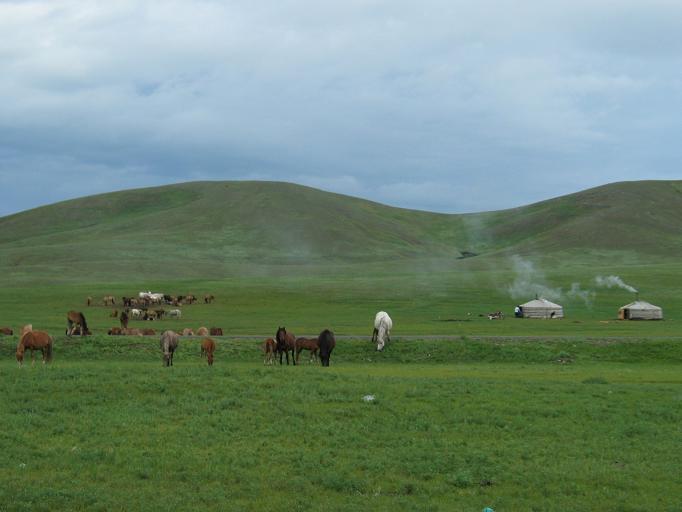
I don't know if we'll see any snow leopards on our four-day excursion to Mongolia's rural landscapes, but if we do, at least we'll know that they're among the 1,200 still in existence in the country. This story also directly relates to our study abroad since we will be visiting with a travel and tourism expert in Mongolia. He might tell us that if the country had allowed the hunting to go through, it might have hurt the economy due to boycotts. I'd like to learn more, especially since we will be visiting the countrysides. --Philip Volmar
South Korea is getting tired of being forgotten in the world of finance, and economics. According to them, no financial strategic risk is posed by North Korea; therefore, investors should begin looking at South Korea as a potential hub for financial markets. Shortly after these claims, a South Korean warship was torpedoed by a North Korean submarine which confirmed investors’ fears: that South Korea is still not ready to be a financial market center. North Korea is not the only thing keeping South Korea from being the next Singapore or Hong Kong, “currency intervention, powerful unions, poor corporate governance and the prospect of capital controls” also prevent South Korea from growing economically to the point of being a major hub. As much as South Korea can hope that it will soon be a swan of commerce, the fate of its country (at least for the next little while) remains to be a financial ugly duckling.
Rich Kuttler
Hong Kong’s inflation rate rose to 3.7 percent, which is the highest it has been in several years. Analysts had expected the inflation rate to be lower, at 3.2 percent. This increase in inflation was boosted by an unusual increase in housing and rent prices. This is a problem because the costs of living are rising steadily for those who live in Hong Kong. Prices are not expected to peak until the year’s end. We will have to see the effect that this has on the overall economy and standard of living for residents of Hong Kong.
Bradley E. McMullin
The article “Asian IPOs are Mixed Bags” discusses the effects of the Japanese earthquake and the overall economy on many different Hong Kong Initial Public Offerings (IPOs). Most companies priced their offerings at the lowest end of their range and ended up having successful offerings. Other companies were not so lucky and $4.2 billion in IPOs have been postponed in Hong Kong and Singapore alone. Another factor that has helped companies price their companies is the presence of cornerstone investors, or investors who pay the same price per share but receive a predetermined number of shares. Throughout this article I got the feeling that while the Asian countries are interconnected and depend on each other for economic stability, the entire world is now connected with each countries business. I found it interesting that the article mentions that although the Japanese disaster threw a glitch in Hong Kong’s IPOs, the rest of the world was still supportive and invested which allowed companies to have successful offerings.
Since the attacks in the Middle East, China has really tightened control over cell phone calls, instant messaging, emails, and Internet sites to limit revolts in China. A man was talking on his phone in Beijing and he said, “The lady doth protest too much, methinks.” After the word “protest” was said one more time in the conversation, the cell phone conversation was cut off. This shows that the government is listening in on cell phone conversations. The Chinese government also has blamed Google saying that emails have not been sent or received because of technical difficulties when it was really the government interfering.
Amie
In Ofunato Japan tsunami refuges have gather in schools, hospitals, and public gyms, etc. The population in this city is 41000 and there are 61 shelters housing about 8450 people. It’s hard for them not only because they are cramped in places with tons of people, but the whether bringing heavy snow and below-freezing temperatures. Military brought portable toilets, food, and water to the city of Ofunato. Also the cities electricity was partly restored, that brought some smiles to the people. Also talking about the earthquake and tsunami as a whole the officials say it’s the nation’s largest humanitarian crisis since World War II with 700000 refugees throughout Japan.
Wall Street Journal, March 17, 2011
Caleb Carpenter